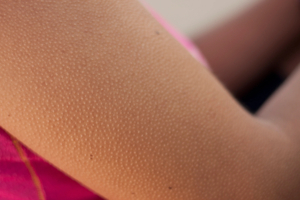
You’re watching a scary movie and suddenly your skin erupts into tiny bumps all over your arms. Or maybe you’re standing outside on a cold winter day and your body covers itself in these mysterious little bumps. Those bumps are called goosebumps, and they appear in certain situations.
But WHY?
What triggers/causes goosebumps?
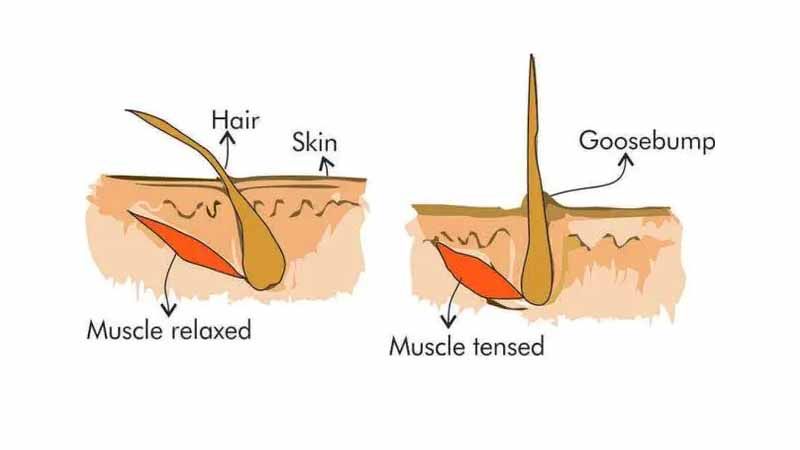
Goosebumps are triggered by your sympathetic nervous system—the part of your nervous system that kicks in during moments of strong emotion, cold, or danger. When you’re scared, cold, or even emotionally moved by something, your body releases a hormone called adrenaline. This hormone tells tiny muscles attached to each of your hair follicles to contract. When these muscles pull, your hair stands up, and the skin around the hair bumps outward. Creating goosebump!
The Strange Part: An Evolutionary Leftover
Here’s the strange part: goosebumps are actually an evolutionary leftover from our ancestors! If you think about our furry primate ancestors, goosebumps would have made them look much bigger and more intimidating to predators. The raised hair made them seem larger and more threatening. Today, humans have lost most of our body hair, so goosebumps don’t really help us look scarier. Yet our bodies still do it automatically. It’s a reflex that served a purpose millions of years ago but is now mostly just a quirky reminder of our evolutionary past.
Cold vs. Emotion
Interestingly, goosebumps can be triggered by both cold and emotion. When you’re cold, the contraction of those tiny muscles actually helps generate heat—it’s your body’s attempt to warm itself up. When you’re emotional—whether from fear, awe, or even inspiration—your sympathetic nervous system activates as part of your emotional response. This is why you might get goosebumps listening to an inspiring speech or watching an amazing movie scene!
Summary
Goosebumps are caused by tiny muscles at the base of your hair follicles contracting in response to adrenaline. Whether you’re cold, scared, or emotionally moved, your sympathetic nervous system triggers this automatic response. While goosebumps once served an important evolutionary purpose—making our ancestors look bigger to predators—they’re now just an interesting reminder of where we came from. Next time you get goosebumps, remember that your body is responding exactly the way it’s done for millions of years!
Sources:
- Cleveland Clinic: Why you have “Goosebumps” on your skin
- NIH: What goosebumps are for
- WebMD: What causes goosebumps?
- NYSCF: Why Do We Get Goosebumps? The Answer Lies with the Stem Cells that Grow Hair
Have you noticed when you tend to get goosebumps? Is it more from cold, fear, or maybe from emotional moments? Share your experiences in the comments below—I’d love to hear what gives you goosebumps!
 WiseWhys
Leave a comment