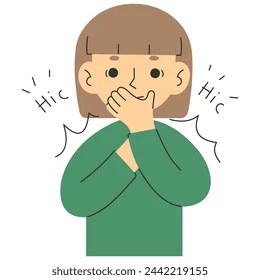
Picture this: You’re sitting in a quiet classroom, completely focused on your work. Suddenly, “hic!” Your body jolts unexpectedly. A few seconds later, “hic!” again. You’re hiccupping, and it seems like your body has its own agenda! But have you ever wondered what’s actually happening inside your body when you hiccup? Why does your diaphragm betray you at the most inconvenient moments?
But WHY?
Hiccups are one of those peculiar biological phenomena that most of us experience regularly, yet few of us truly understand. They’re involuntary, they’re unpredictable, and sometimes they just won’t go away! But there’s fascinating science behind this annoying reflex.
What Exactly is a Hiccup?
A hiccup is an involuntary contraction of your diaphragm—the large muscle located just below your lungs that controls your breathing. When you hiccup, your diaphragm suddenly and unexpectedly contracts, causing you to quickly inhale. At the precise moment your vocal cords snap shut, which produces that distinctive “hic” sound.
The whole process happens in milliseconds, but it’s a complex chain of events involving your nervous system, your muscles, and even your brain’s reflexes.
Why Do We Hiccup and What Triggers It?
Hiccups can be triggered by a variety of things, though the exact cause isn’t always obvious:
- Sudden Temperature Changes: Drinking something hot followed immediately by something cold can irritate your nerves and trigger hiccups.
- Swallowing Problems: Sometimes swallowing incorrectly or too quickly can irritate the phrenic nerve.
- Stomach Distension: Eating too quickly, eating too much, or consuming carbonated beverages can stretch your stomach, irritating the phrenic nerve beneath it.
- Excitement or Stress: Emotional changes can sometimes trigger hiccups.
- Irritation of the Stomach or Esophagus: Spicy food, hot liquid, or swallowing something scratchy can cause irritation.
But here’s the truly curious part: Scientists still aren’t entirely sure why we have hiccups! This reflex seems like an evolutionary leftover from our ancestors. Some theories suggest that hiccups might be related to our evolutionary past as aquatic creatures. Amphibians have a similar reflex, and some researchers believe hiccups might be a remnant from when our distant ancestors transitioned from water to land.
Another theory suggests that hiccups might have served a purpose in clearing the esophagus or protecting our airways, but modern humans rarely need this function anymore. It’s essentially a useless reflex that stuck around through evolution.

Why Are Hiccups So Hard to Stop?
Once hiccups start, they can be maddeningly persistent. This is because your hiccup reflex is relatively independent of your conscious control. You can’t simply “tell” your diaphragm to stop contracting the way you can move your arm or blink your eyes.
That’s why all those folk remedies exist—holding your breath, drinking water upside down, getting scared, or breathing into a paper bag. These methods work (sometimes) by overriding the hiccup reflex with other stimuli. For example, holding your breath increases carbon dioxide in your blood, which eventually overrides the hiccup signal. Getting scared activates your sympathetic nervous system, which can interrupt the reflex.
Fun Fact – The Evolutionary Mystery
What makes hiccups truly fascinating is that they’re a reminder of our evolutionary history. Our bodies carry remnants of ancient features that once served important purposes but have since become obsolete. Hiccups are like a biological Easter egg—a quirk that scientists are still trying to fully understand. Some researchers believe hiccups may be a leftover from our fish-like ancestors, who used similar contractions to move water through their gills!
Summary
Hiccups are involuntary contractions of your diaphragm triggered by irritation of the phrenic or vagus nerves. When your diaphragm contracts, air rushes into your lungs, and your vocal cords snap shut, creating that distinctive “hic” sound. While we’re still not entirely certain why we have hiccups, they appear to be an evolutionary relic from our distant past. Fortunately, most hiccup episodes last just a few minutes and resolve on their own!
What’s your most annoying hiccup story? Do you have a home remedy that actually works? Leave your comments below—I’d love to hear about your experiences!
Links to Similar Studies
- National Institutes of Health (NIH): Hiccup Reflex and Neurophysiology
- Mayo Clinic: Hiccups – Causes and Solutions
- Journal of Neuroscience: Evolutionary Perspectives on Involuntary Reflexes
- American Medical Association: Persistent Hiccups and Medical Treatment
Good to know about DOMS. Informative.

More Posts:
 WiseWhys
Leave a comment