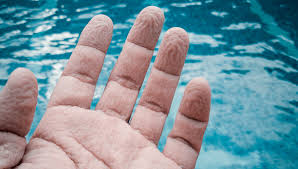
Imagine you are at the pool, you get out of the pool to get something to drink. You grab a glass of water, but you realize it feels different. Then you look at your hands and see that they have wrinkled up like dried prunes.
But WHY?
Your Epidermis is covered/protected with Sebum oil that protects, lubricates and moistens the skin, however staying in water for prolonged periods of time will wash away the Sebum oil. Before thorough research, it was believed that the cause of water-wrinkling was the outer layer of the skin, the Epidermis layer, absorbing the water and swelling up irregularly to create the wrinkling effects. This original theory was very feasible, as it is known that the Sebum oil lubricating the Epidermis can indeed be washed away, allowing the Epidermis to absorb water to small amounts. However, when this theory was being tested, it was shown that fingers with nerve damage didn’t swell up in water, even after long periods. This means that the wrinkling of the fingers is an involuntary reaction of the nervous system, the system that controls breathing, heart rate, and perspiration. Therefore, our fingers wrinkling after a long time in water is probably not fully due to the Epidermis absorbing water, as that is not a nervous function.
To find out the exact reason for water wrinkling your fingers, Mark Changizi and his colleagues decided to study the topic. Mark Changizi is an evolutionary neurobiologist who works at 2AI Labs in Boise, Idaho. They suggest that wrinkling is optimized for providing a drainage network of water from the skin to enhance grip underwater. Furthermore, they suggest that skin wrinkling is an evolutionary process that helped our ancestors to survive.
But, “What is the Evolutionary Function?” The evolutionary function that makes your finger wrinkle after a long time in water is Vasoconstriction, commonly known as the narrowing of the blood vessels. Vasoconstriction is a theory that has been gaining a huge amount of recognition. The theory states: When your hands have been submerged in water for a long time, the nerve fibers are triggered to “shrink” and Glomus bodies(bodies in the skin that regulate and measure temperature) lose volume. Due to the shrinking internals of the finger, the skin on our fingertips start to cave in, forming the visible wrinkles. To further back this theory up, Hsieh et al.’s research shows that nerve functionality correlates with finger wrinkling. To expand, the better your fingers can react to nervous responses, the more wrinkling your fingers will have, and vice versa.
However, this theory fails to explain why it is only/mainly the fingertips and toes that become wrinkly underwater. This is where another theory comes into the spotlight. The most popular theory that explains why water-caused wrinkling happens only on your fingertips and toes is the Dead Keratin Theory. The theory goes as follows: Keratin, a protein found in hair, nails, and the outermost layer of the skin, dies when it is separated from the skin. Your fingertips and toes are the most worn and torn part of our skin, therefore there are a lot of dead Keratin cells on your fingertips and toes. The dead Keratin cells absorb the water and swell, creating abnormal ridges and wrinkles on your fingertips and toes. The “Dead Keratin theory” goes perfectly along with the “Vasoconstriction theory” to explain why our skin wrinkles after long periods of time in the water, and why it happens mostly on our fingertips and toes.
While we can’t be completely sure of why our skin wrinkles in the water, we can try our best to use our current knowledge to examine the scientific inquiry and solve it as precisely as possible. However, scientists can confirm that water-caused wrinkling is an evolutionary nervous process. Additionally, research has shown that the wrinkling does improve gripping ability, making it easier to hold onto wet objects under water.
What do you think ? Leave your comments below, if you have anything to share!
Article Summary:
The nerves in your fingers contract and shrink in size creating the pudgy and wrinkly effects on your wet fingers. However, only fingers becomes wrinkled when wet because the amount of dead keratin cells on your fingers and toes absorb water, which creates the wrinkly ridges on your fingers and toes.
Links to similar Studies
- Scientific American: https://www.scientificamerican.com/article/why-do-our-fingers-and-toes-wrinkle-during-a-bath/
- Kids Health: https://kidshealth.org/en/kids/wrinkly-fingers.html
- Medical News Today: https://www.medicalnewstoday.com/articles/322705
 WiseWhys